PMO Robotics / Invention 17
AtmosPouch
A solar-assisted emergency device concept that pulls water vapor from humid air, condenses it, treats the collected water, verifies operating conditions and fills a sealed pouch.
Evidence boundary: AtmosPouch is not a certified drinking-water device. Output depends strongly on temperature and humidity, and no potable-water, production-rate, efficiency or field-readiness claim exists until independently measured and reviewed.
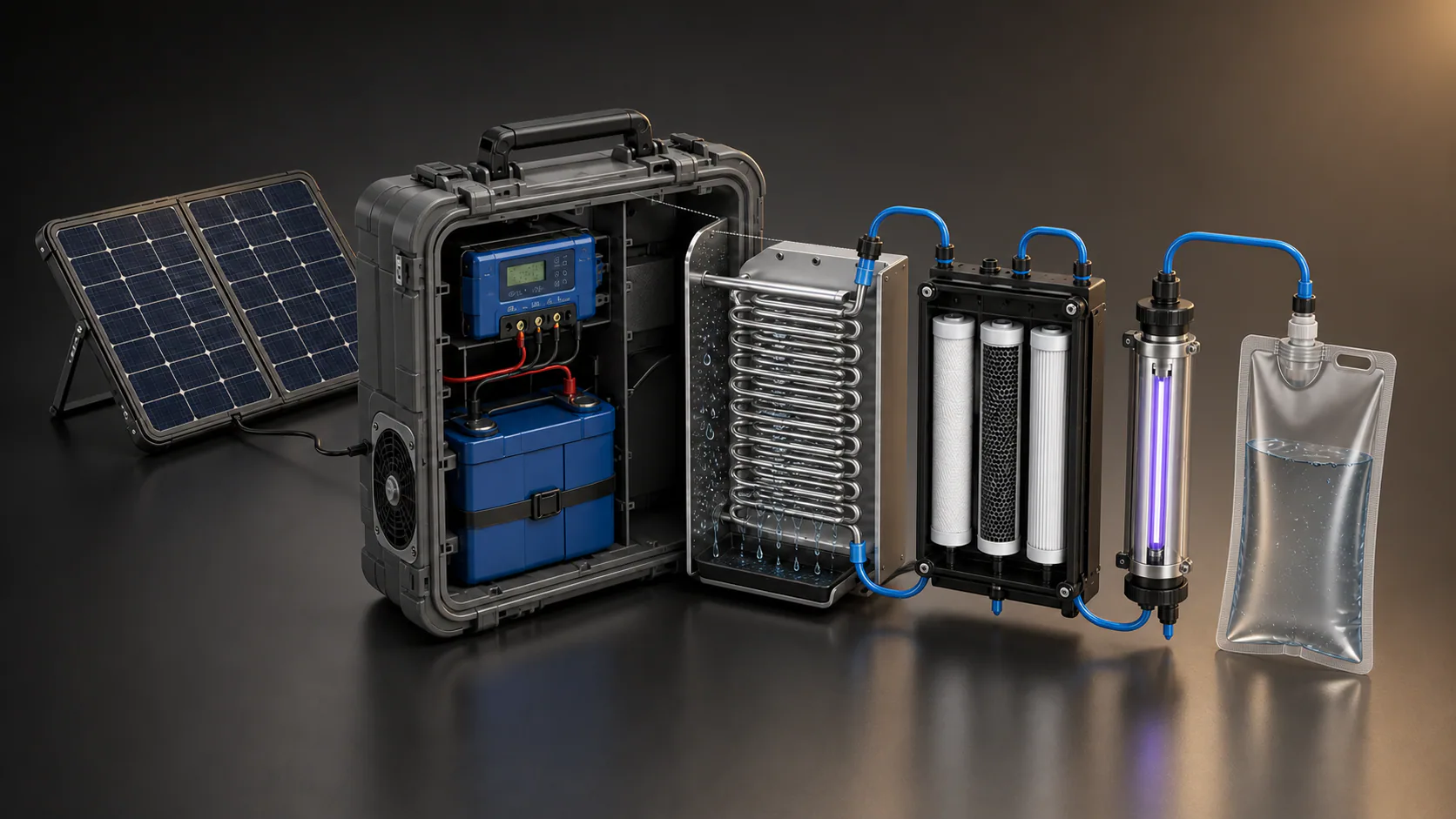
01 · System architecture
Capture, treat, verify and package
Air intake
Screened airflow path with temperature, humidity and flow sensing.
Measure source state
Condensation
Refrigeration/dehumidification stage sized from measured dew point and expected water yield.
Measure energy per liter
Collection
Closed food-contact drainage and reservoir designed to limit recontamination.
Sanitation review
Treatment
Sediment and activated-carbon stages followed by a validated disinfection process appropriate to the actual hazards.
Water engineer
Verification
Flow, temperature, conductivity/turbidity where appropriate, filter-life, UV status and sample records.
Independent lab tests
Pouch filling
Clean, controlled fill path using compatible sealed pouches and traceable batch records.
Packaging review
02 · Power module
Solar-battery planning build
Solar array
400–600 W
Battery
12/24 V LiFePO₄, 1–1.5 kWh
Charge control
MPPT with PV disconnect
AC conversion
600–1,000 W pure sine
DC distribution
Fused fan, pump, sensors and controls
Design rule
Net yield must include all parasitic loads
03 · Energy flow
Every watt is accounted for
- Solar input Measure irradiance and electrical energy entering storage.
- Stored energy Track battery state and conversion losses.
- Condensation load Measure compressor, fan and defrost consumption.
- Treatment load Measure pumps, sensors and disinfection energy.
- Net result Report liters collected and treated per measured kWh.
04 · Prototype sequence
Build the measurement rig before the field enclosure
Power bench
Validate protected solar, battery, DC and inverter paths with dummy loads.
Gate: stable output and verified protectionCondensation bench
Measure hourly water yield across controlled humidity and temperature points.
Gate: repeatable liters-per-kWh curveSanitary collection loop
Add closed drainage, cleanable reservoir and treatment train.
Gate: materials and sanitation reviewInstrumented pouch filler
Fill sample pouches under a documented cleaning and sampling procedure.
Gate: seal integrity and contamination controlsIntegrated enclosure
Combine subsystems only after bench measurements support the thermal and electrical design.
Gate: endurance, fault and restart testsIndependent validation
Use a qualified laboratory and relevant authorities before any drinking-water use.
Gate: documented approval for intended use05 · First build list
Functional component categories
- Commercial dehumidifier or refrigeration test module
- Temperature, relative-humidity and dew-point sensing
- True-energy meter for condenser and parasitic loads
- LiFePO₄ battery with BMS, fuses and disconnects
- MPPT controller, PV-rated wiring and protected enclosure
- Food-contact reservoir, tubing, fittings and sample ports
- Sediment and activated-carbon filter housings
- Professionally reviewed disinfection stage and interlocks
- Clean pouch connector, controlled fill valve and seal tester
06 · Failure criteria
Stop or redesign when evidence fails
- Net water yield is impractical at the target climate.
- Parasitic energy eliminates the useful production rate.
- Condensate or treatment output fails water-quality requirements.
- Wetted materials cannot be safely cleaned or verified.
- UV or electrical interlocks permit unsafe exposure or operation.
- Packaging allows leakage, recontamination or misleading shelf-life claims.
- Cost per verified liter is not competitive for the intended mission.
07 · Immediate next experiment
Produce the climate-performance map
Run a controlled dehumidifier bench test at several temperature and relative-humidity points. Independently measure electrical energy, condensate mass, ambient state and every auxiliary load. The first decision is whether the measured liters-per-kWh curve justifies treatment and pouch-filling development.
No procurement, construction, potable use or field deployment is authorized by this concept record.